


Nickel-Chromium Resistance Alloys
- Nickel-chromium (NiCr) electric heating alloys are a type of high-resistance heating material primarily composed of nickel (Ni) and chromium (Cr), widely used in electric heating elements. Their key characteristics and performance are as follows:
- • High resistivity: The resistivity usually ranges from 1.04 to 1.18 μΩ·m (20℃), making it suitable for efficient electric-heat conversion.
- • High operating temperature: The maximum operating temperature can reach 1100–1250℃ (for instance, Cr20Ni80 can reach 1200℃, and some optimized grades can reach 1250℃).
- • Excellent oxidation resistance: Forms a dense Cr₂O₃ oxide layer on the surface, effectively preventing further oxidation.
- • Good high-temperature strength and plasticity: Resistant to deformation at high temperatures, not prone to embrittlement after long-term use, facilitating maintenance and reprocessing.
- • Non-magnetic: Suitable for low-temperature or precision equipment sensitive to magnetic fields.
- • Low temperature coefficient of resistance: Ensures that the resistance remains relatively stable with temperature changes, suitable for precise temperature control applications.• Low temperature coefficient of resistance: Ensures that the resistance remains relatively stable with temperature changes, suitable for precise temperature control applications.
- • Good machinability and weldability: Can be drawn into wires, rolled into strips, and supports various connection methods such as arc welding and gas welding.
- Advantages and disadvantages compared with other heating alloys:
- • Superior to iron-chromium-aluminum (FeCrAl):
- o Higher high-temperature strength and creep resistance;
- o Retains plasticity after long-term use and is less prone to brittle fracture;
- o Non-magnetic (FeCrAl is magnetic below >600℃);
- o Better corrosion resistance (except in sulfur-containing atmospheres).
- • Inferior to iron-chromium-aluminum:
- o Higher cost (due to nickel content);
- o Slightly lower resistivity;
- o Susceptible to corrosion in sulfur-containing reducing atmospheres.
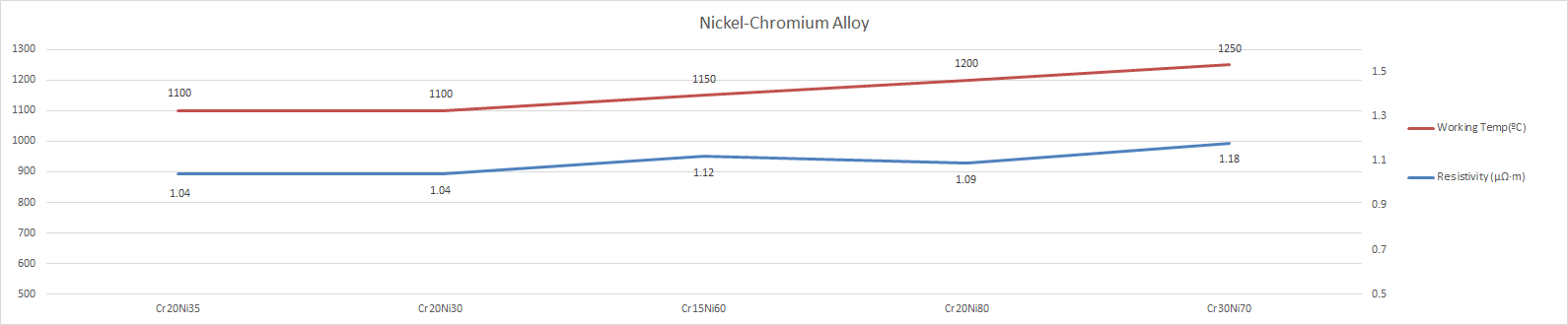


Main Properties and Characteristics of Nickel-Chromium and Nickel-Chromium-Iron Material
(Swipe the screen to view the full table)
Alloy Name Properties
|
Cr20Ni80 | Cr30Ni70 | Cr15Ni60 | Cr20Ni35 | Cr20Ni30 | |
|---|---|---|---|---|---|---|
| Main Chemical Components |
Ni | Remainder | Remainder | 55.0-61.0 | 34.0-37.0 | 30.0-34.0 |
| Cr | 20.0-23.0 | 28.0-31.0 | 15.0-18.0 | 18.0-21.0 | 18.0-21.0 | |
| Fe | ≤1.0 | ≤1.0 | Remainder | Remainder | Remainder | |
| Maximum operating temperature | 1200 | 1250 | 1150 | 1100 | 1100 | |
| Resistivity 20ºC (μΩ·m) | 1.09±0.05 | 1.18±0.05 | 1.12±0.05 | 1.04±0.05 | 1.04±0.05 | |
| Density(g/cm3) | 8.40 | 8.10 | 8.20 | 7.90 | 7.90 | |
| Coefficient of heat conductivity (20ºC) (W/m·K) |
15 | 14 | 13 | 13 | 13 | |
| Coefficient of linear expansion (20ºC ~ 1000ºC) (α×10-6/ºC) |
18.0 | 17.0 | 17.0 | 19.0 | 19.0 | |
| Melting point(ºC) | 1400 | 1380 | 1390 | 1390 | 1390 | |
| Tensile strength(Rm/MPa) | ≥650 | ≥650 | ≥600 | ≥600 | ≥600 | |
| Elongation after Fracture (A/%) | ≥20 | ≥20 | ≥20 | ≥20 | ≥20 | |
| Accelerated life test(Hours/ºC) | ≥80/1200 | ≥50/1250 | ≥80/1150 | ≥80/1100 | ≥50/1100 | |
| Microscopic structure | Austenite | Austenite | Austenite | Austenite | Austenite | |
| Magnetism | Non-magnetic | Non-magnetic | Weak magnetic | Non-magnetic | Non-magnetic | |
The temperature correction factor for Nickel-Chrome and Nickel-Chrome-Iron alloys
|
Temp(ºC) |
20 |
100 |
200 |
300 |
400 |
500 |
600 |
700 |
800 |
900 |
1000 |
1100 |
1200 |
|---|---|---|---|---|---|---|---|---|---|---|---|---|---|
|
Cr20Ni80 |
1 |
1.006 |
1.012 |
1.018 |
1.025 |
1.026 |
1.018 |
1.01 |
1.008 |
1.01 |
1.014 |
1.021 |
1.025 |
|
Cr30Ni70 |
1 |
1.007 |
1.016 |
1.028 |
1.038 |
1.044 |
1.036 |
1.03 |
1.028 |
1.029 |
1.033 |
1.037 |
1.043 |
|
Cr15Ni60 |
1 |
1.011 |
1.024 |
1.038 |
1.052 |
1.064 |
1.069 |
1.073 |
1.078 |
1.088 |
1.095 |
1.109 |
|
|
Cr20Ni35 |
1 |
1.029 |
1.061 |
1.09 |
1.115 |
1.139 |
1.157 |
1.173 |
1.188 |
1.208 |
1.219 |
1.228 |
|
|
Cr20Ni30 |
1 |
1.023 |
1.052 |
1.079 |
1.103 |
1.125 |
1.141 |
1.158 |
1.173 |
1.187 |
1.201 |
1.214 |
1.226 |
| – To obtain resistance at working temperature, multiply by the factor in above table. | |||||||||||||