


Iron-Chromium-Aluminum Resistance Alloys
- Iron-Chromium-Aluminum(FeCrAl) electric heating alloy is a high-temperature electrical heating material primarily composed of iron, chromium, and aluminum, widely used in industrial and civilian heating equipment. Its core features and properties are as follows:
- • High Electrical Resistivity: Room temperature resistivity is 1.23–1.53 μΩ·m, higher than that of nichrome alloys, which helps save material and improve heating efficiency.
- • Excellent High-Temperature Oxidation Resistance: The surface forms a dense Al₂O₃ oxide film, with a maximum service temperature of 1300–1400°C (depending on the grade).
- • Low Density: Approximately 7.10–7.40 g/cm³, lighter than nichrome alloys, allowing weight reduction for components of the same size.
- • Low Cost: Contains little or no nickel, making the raw material cost significantly lower than that of nichrome alloys.
- • Good Sulfur Resistance: Superior corrosion resistance in sulfur-containing atmospheres compared to nichrome alloys.
- • High Non-Magnetic Temperature: Magnetic properties are retained until >600°C; attention should be paid to magnetic effects during low-temperature use.
- Limitations:
- • High Brittleness at Room Temperature: Hard and brittle texture, not suitable for cold bending or impact; preheating to 300–500°C is required before processing.
- • Low High-Temperature Strength: Plasticity increases with temperature rise, prone to deformation and collapse, requiring proper support.
- • 475°C Brittleness: Long-term exposure around ~475°C may reduce toughness due to phase transformation.
- • Atmospheric Limitations: Not suitable for atmospheres containing nitrogen, chlorine, or halogens; performs better than nichrome alloys in sulfur-containing combustion atmospheres.
- • High Welding Requirements: Argon arc welding (TIG) with inert gas protection is necessary; post-weld annealing at 800°C is recommended to eliminate brittleness.
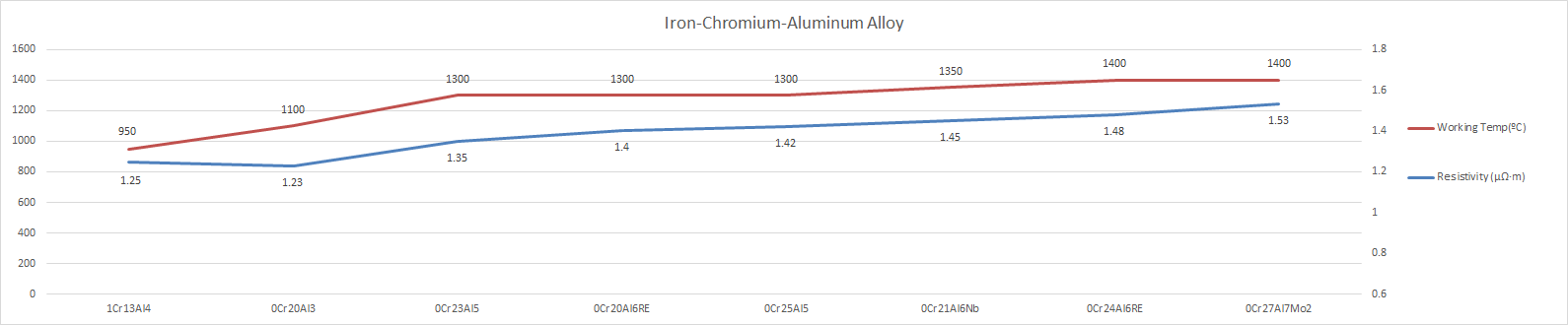


Main Properties and Characteristics of Iron-Chromium-Aluminum(FeCrAl) High Resistance Alloy Materials
(Swipe the screen to view the full table)
Alloy Name Properties
|
1Cr13Al4 | 0Cr25Al5 | 0Cr20Al6RE | 0Cr23Al5 | 0Cr20Al3 | 0Cr21Al6Nb | 0Cr24Al6RE | 0Cr27Al7Mo2 | |
|---|---|---|---|---|---|---|---|---|---|
|
Main
Chemical Components |
Cr | 12.0-15.0 | 23.0-26.0 | 19.0-21.0 | 20.5-23.5 | 18.0-21.0 | 21.0-23.0 | 22.0-26.0 | 26.5-27.8 |
| Al | 4.0-6.0 | 4.5-6.5 | 5.0-6.0 | 4.2-5.3 | 3.0-4.2 | 5.0-7.0 | 5.0-7.0 | 6.0-7.0 | |
| RE | Opportune | Opportune | 0.04-1.0 | Opportune | Opportune | Opportune | 0.04-1.0 | Opportune | |
| Fe | Remainder | Remainder | Remainder | Remainder | Remainder | Remainder | Remainder | Remainder | |
| Other | Nb0.5 | Mo1.8-2.2 | |||||||
| Maximum operating temperature | 950 | 1300 | 1300 | 1300 | 1100 | 1350 | 1400 | 1400 | |
| Resistivity 20ºC (μΩ·m) | 1.25±0.08 | 1.42±0.07 | 1.40±0.07 | 1.35±0.07 | 1.23±0.07 | 1.45±0.07 | 1.48±0.07 | 1.53±0.07 | |
| Density (g/cm 3 ) | 7.40 | 7.10 | 7.20 | 7.25 | 7.35 | 7.10 | 7.1 | 7.10 | |
|
Coefficient of heat conductivity
(20ºC) (W/m·K) |
15 | 13 | 13 | 13 | 13 | 13 | 13 | 13 | |
|
Average linear expansion coefficient
(20~1000ºC)(α×10 -6 /ºC) |
15.4 | 15.0 | 14.0 | 15.0 | 13.5 | 16.0 | 16.0 | 16.0 | |
| Melting point(ºC) | 1450 | 1500 | 1500 | 1500 | 1500 | 1510 | 1520 | 1520 | |
| Tensile strength(R m /MPa) | ≥580 | ≥600 | ≥600 | ≥600 | ≥580 | ≥650 | ≥680 | ≥680 | |
| Elongation after Fracture (A/%) | ≥12 | ≥12 | ≥12 | ≥12 | ≥12 | ≥10 | ≥10 | ≥10 | |
|
Accelerated life test
(Hours/ºC) |
-- | ≥80/1300 | ≥80/1300 | ≥80/1300 | ≥80/1250 | ≥50/1350 | ≥80/1350 | ≥50/1350 | |
| Microscopic structure | Ferrite | Ferrite | Ferrite | Ferrite | Ferrite | Ferrite | Ferrite | Ferrite | |
| Magnetism | Magnetic | Magnetic | Magnetic | Magnetic | Magnetic | Magnetic | Magnetic | Magnetic | |
The temperature correction factor for Iron-Chromium-Alumiuim alloys
| Temp.( ºC) | 20 | 100 | 200 | 300 | 400 | 500 | 600 | 700 | 800 | 900 | 1000 | 1100 | 1200 |
|---|---|---|---|---|---|---|---|---|---|---|---|---|---|
| 1Cr13A14 | 1 | 1.005 | 1.014 | 1.028 | 1.044 | 1.064 | 1.09 | 1.12 | 1.132 | 1.142 | 1.15 | ||
| 0Cr20A13 | 1 | 1.011 | 1.025 | 1.042 | 1.061 | 1.085 | 1.12 | 1.142 | 1.154 | 1.164 | 1.172 | 1.180 | 1.186 |
| 0Cr23Al5 | 1 | 1.002 | 1007 | 1.014 | 1.024 | 1.036 | 1.056 | 1.064 | 1.070 | 1.074 | 1.078 | 1.081 | 1.084 |
| 0Cr25A15 | 1 | 1.002 | 1.005 | 1.008 | 1.013 | 1.021 | 1.03 | 1.038 | 1.04 | 1.042 | 1.044 | 1.045 | 1.047 |
| 0Cr20Al6RE | 1 | 1.002 | 1.005 | 1.010 | 1.015 | 1.021 | 1.029 | 1.035 | 1.039 | 1.042 | 1.044 | 1.046 | 1.047 |
| 0Cr21Al6Nb | 1 | 0.997 | 0.996 | 0.994 | 0.991 | 0.99 | 0.99 | 0.99 | 0.99 | 0.99 | 0.99 | 0.99 | 0.99 |
| 0Cr24Al6RE | 1 | 0.995 | 0.993 | 0.990 | 0.988 | 0.986 | 0.984 | 0.982 | 0.98 | 0.978 | 0.976 | 0.976 | 0.975 |
| 0Cr27A17Mo2 | 1 | 0.992 | 0.986 | 0.981 | 0.978 | 0.976 | 0.974 | 0.972 | 0.97 | 0.969 | 0.968 | 0.968 | 0.967 |
| – To obtain resistance at working temperature, multiply by the factor in above table. | |||||||||||||