



Stranded Heating Ropes
-
Stranded Heating Ropes
(composed of multiple twisted heating wires, commonly 7, 19, or 37 strands) offer significant advantages
over
Single Solid Heating Wires
in terms of structural mechanics, thermal performance, and application flexibility. This design is not
merely a "parallel connection" of multiple wires but achieves a qualitative leap in performance through the
stranding process.
1. Superior Flexibility and Fatigue Resistance
This is the most critical advantage of stranded heating ropes.
-
Limitation of Solid Wires: According to materials mechanics, the bending stiffness of a solid wire is
proportional to the fourth power of its diameter (
 ). When a single heating wire has a large diameter (to achieve high power), it becomes extremely rigid and
difficult to bend. If forcibly bent repeatedly, it is highly prone to metal fatigue fracture.
). When a single heating wire has a large diameter (to achieve high power), it becomes extremely rigid and
difficult to bend. If forcibly bent repeatedly, it is highly prone to metal fatigue fracture.
- Advantage of Stranded Wires: By distributing the same total cross-sectional area into multiple fine strands (e.g., 7, 19, or 37) and twisting them together, the equivalent bending stiffness of the entire cable is drastically reduced.
- Dynamic Applications: In scenarios requiring movement, coiling, or vibration (e.g., movable heating blankets, robot joint heating, pipe trace heating), the stranded structure can withstand millions of bending cycles without breaking.
- Installation Convenience: It can be tightly wound around objects with complex shapes (e.g., valves, irregular containers, medical catheter tubes), achieving extremely high conformity with no air gaps.
- Increased Surface Area: Multiple stranded conductors provide a significantly larger total surface area compared to a single solid wire of the same cross-sectional area.
- Heat Dissipation Efficiency: The larger surface area facilitates faster heat transfer from the conductor's interior to the external insulation layer and the heated object, reducing heat accumulation inside the conductor.
- Heating Speed: Due to shorter heat conduction paths (smaller radius of individual strands), stranded heating ropes have a shorter Thermal Response Time, reaching the set temperature much faster.
- Current Distribution: In AC applications, the stranded structure (especially variants similar to Litz wire) helps distribute current more evenly across the cross-section, avoiding the wasted material utilization caused by low current density in the center of a single thick wire.
- Stress Dispersion: During installation tension or thermal expansion, the stranded structure allows for slight relative sliding between individual strands, thereby absorbing internal stresses. This prevents fractures caused by huge internal stresses generated from thermal expansion and contraction.
- Tolerance to Local Defects: For a single solid wire, a micro-crack on the surface can rapidly propagate under stress, leading to a complete circuit break. In a multi-strand rope, even if individual fine strands break due to manufacturing defects or extreme external forces, the remaining strands can maintain circuit continuity and heating function (though power may slightly decrease), providing higher system safety.
-
Limitation of Solid Wires: According to materials mechanics, the bending stiffness of a solid wire is
proportional to the fourth power of its diameter (
| Stranding Structure | Composition | Characteristics & Application Scenarios |
|---|---|---|
| 7-Strand (1+6) | 1 central wire + 6 outer wires | Basic Flexibility . Softer than a single wire, suitable for general bending installations; lower cost. Commonly used in standard household heating elements or simple industrial trace heating. |
| 19-Strand (1+6+12) | 1 central + 6 middle + 12 outer | High Flexibility . Two-layer stranding makes the wire rounder and softer, significantly improving bending resistance. Often used in medical devices and aerospace cables requiring frequent movement or small bending radii. |
| 37-Strand (1+6+12+18) | Three-layer stranding | Ultra-High Flexibility . Approaches the softness of a rope, capable of withstanding extremely small bending radii and severe vibration. Dedicated to high-end precision instruments, micro-heaters, and extreme vibration environments (e.g., heating around engines). |
Summary: Stranded Heating Rope vs. Single Solid Heating Wire
| Feature | Single Solid Heating Wire | Multi-Strand Stranded Heating Rope |
|---|---|---|
| Flexibility | Poor; very rigid at large diameters | Excellent ; can be bent or knotted freely |
| Fatigue Resistance | Low; prone to breaking upon repeated bending | High ; suitable for dynamic and vibrating environments |
| Thermal Response | Slower; slow heat dissipation from the center | Fast ; large surface area, uniform heat dissipation |
| Conformity | Difficult to fit complex curved surfaces | Perfect Fit ; no air gaps, high thermal efficiency |
| Cost | Lower; simple manufacturing process | Higher; complex stranding process |
| Typical Applications | Fixed heating tubes, electric furnace coils, simple heaters | Movable heating pads, pipe trace heating, medical catheter heating, aircraft de-icing |
One-Sentence Summary
- By adopting a "divide and conquer" structural design, multi-strand stranded heating ropes sacrifice a small amount of manufacturing cost to gain a qualitative leap in flexibility, fatigue resistance, and heat exchange efficiency , making them the only ideal solution for complex shape heating and dynamic heating scenarios.
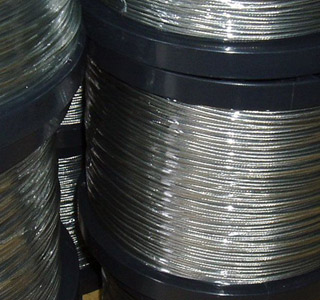


Specifications and Characteristics for commonly used stranded resistance wire
(Swipe the screen to view the full table)
|
Alloy |
Total diameter nominal(mm) |
Strands × size(mm) |
King wire size(mm) |
Resistance per meter(Ω/m) |
Length per kg(m/kg) |
Weight per meter(g/m) |
|
Cr20Ni80 |
2.76 |
37 × 0.385 |
0.450 |
0.2794 |
28 |
36 |
|
Cr20Ni80 |
2.67 |
19 × 0.523 |
0.574 |
0.2850 |
29 |
34 |
|
Cr20Ni80 |
2.87 |
19 × 0.574 |
0.574 |
0.2394 |
25 |
41 |
|
Cr15Ni60 |
2.76 |
19 × 0.523 |
0.574 |
0.2902 |
30 |
34 |
|
Pure Nickel(N6) |
2.87 |
19 × 0.574 |
0.574 |
0.0198 |
21 |
47 |
Other stranded wire sizes and specifications are available upon request.